Three year olds
Language Arts
The Language Arts skills of listening, speaking, pre-reading and pre-writing are incorporated into every aspect of the three year old program. Children develop competencies in listening and speaking by: following simple verbal directions; listening while others speak; expressing needs and desires in complete sentences; and participating during group times. Children's pre-reading and pre-writing readiness skills are developed as students recognize their name in print, listen to stories, and use tools such as crayons, markers, and paintbrushes in a purposeful manner. Developmentally appropriate experiences and activities such as Morning Meeting, dramatic play, stories, music, names posted on cubbies and artwork, and talking with friends and teachers offer children ongoing opportunities to become effective communicators.
Math
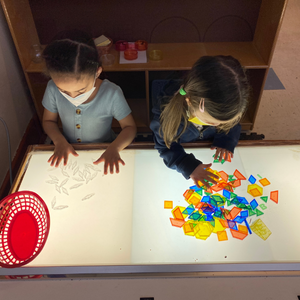
Children are encouraged to explore math concepts through daily experiences and hands-on activities integrated into all areas of the curriculum. Children develop math skills including counting, identifying simple shapes, patterning, and classifying through activities such as passing out snack each day, finger plays, songs, puzzles, and blocks.
Science
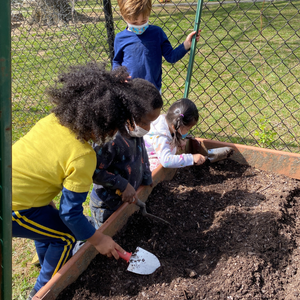
The science program focuses on the children's direct experience of themselves and the world around them. Life, earth and physical sciences are explored through hands-on activities integrated throughout the curriculum. Children have opportunities to observe, describe, compare, classify, question, predict, experiment and record. Planned activities and spontaneous discoveries encourage excitement about phenomena such as freezing and melting, sinking and floating, plant and animal growth, seasonal changes, and magnetic properties.
Physical Education
The physical education program for three year olds provides movement experiences that encourage children to explore spatial relationships, develop physical skills and enjoy movement challenges. A variety of activities and equipment are used to increase agility, coordination and strength.
Four year olds
Language Arts
The Language Arts skills of listening, speaking, pre-reading and pre-writing are integrated into all aspects of the four year old program. Meaningful, developmentally appropriate, child-centered activities such as Morning Meeting, the writing center, and the creation of class stories offer children ongoing opportunities to become effective communicators. Children develop skills in listening and speaking through experiences such as: following three-step oral directions; listening while others speak; and retelling the main parts of a story. A print rich environment supports the foundation for pre-reading and pre-writing skills such as: recognizing beginning sounds in words; creating rhymes; developing correct pincer grip of writing tools; and writing their first name.
Math
Four year old children are encouraged to explore math concepts through developmentally appropriate daily activities and experiences with hands-on materials. Puzzles, blocks, and sensory materials such as sand and water, and calendars, graphs, and cooking activities help children develop mathematical thinking skills such as: counting with 1:1 correspondence; identifying shapes; comparing and contrasting; and predicting outcomes.
Science
The Four year old science program encourages students to develop an awareness and appreciation of the natural world. Life, earth and physical sciences are explored through hands-on experiences integrated throughout the curriculum. Children have opportunities to work with simple scientific tools and to observe, question, compare, classify, predict, experiment, and record. Both indoor and outdoor learning experiences encourage excitement about phenomena such as: seasonal changes; caring for the environment; animal habitats and life cycles; the growth and health of our bodies; movement and gravity; and magnetism.
Kindergarten
Language Arts
The Kindergarten Language Arts curriculum uses the Balanced Literacy approach which includes listening, speaking, reading readiness, reading, writing and handwriting. Emphasis is placed on the process of reading and writing and on the fundamental motor-perceptual skills necessary for those processes. Children are immersed in language and print on a daily basis and are given plenty of time for independent reading and writing. Children participate in small reading groups that focus on phonemic awareness and early reading strategies.
Mathematics
Students in Kindergarten explore a variety of mathematical ideas with concrete materials. These physical activities help foster the learning of abstract ideas. The program provides opportunities for the children to develop and appreciate mathematics, and to become confident in their own ability to think mathematically. Children are encouraged to use mathematics to solve problems in their everyday lives. Mathematics is integrated as much as possible with other areas of the curriculum.
Science
Students are exposed to earth, life and physical sciences with an emphasis on hands-on learning. In each activity, students predict, observe, and record information as they follow the scientific method to learn more about themselves and their environment. Kindergarten students investigate many topics including the five senses, rocks and minerals, and life cycles.
Social Studies
Kindergarten students continue to learn about the environment in which we live. They develop an increased understanding, enjoyment and respect of their community as well as their own cultural heritage and that of others. They also learn the importance of preserving the environment through recycling, reusing and conserving natural resources.
Spanish
Foreign Language instruction begins in Kindergarten and students have Spanish class two times per week. Students develop communicative competence as they feel the need to exchange information with one another and the teacher through songs, games and short dialogues, all conducted in Spanish.
Physical Education
Kindergarten students continue to review skills introduced in pre-school. Through specific exercises students continue to demonstrate body strength, agility and coordination. Performing balance activites, warm-ups to increase flexibility, developing hand-eye coordination, weight transfer, and demonstrating cardio-respiratory endurance are important aspects of the curriculum.